If you are reading this blog, then you ought to owe your allegiance to Vint Cerf.
Vinton Cerf and Bob Kahn are the creators of TCP/IP, the backbone protocol of the Internet. Quite commonly referred to as one of the "Founding Fathers of Internet", Vint is currently a Vice President and the Chief Internet Evangelist at Google. He and Bob Kahn jointly received the ACM Turing award in 2004.
Vint was in Bangalore recently, and Google had arranged for a talk by him as part of its Speaker Series program in Bangalore. I was lucky to attend Vint's talk on the future of Internet. I must say he looked quite jovial and energetic, considering he is in his sixties.
Vint started the talk with a peek into the history of Internet and how TCP/IP came into existence. In one of his slides, he had a photo of himself, wearing a T-shirt with the caption "I P on everything". On Googling more, I just found out that his T-shirt had caused quite some stir at an IETF conference in 1992. And why not!!! IP was going to become a world standard.
During his talk, Vint gave plenty of examples how Internet is making its presence felt in every walk of modern human life. He also hinted at a couple of unsolved questions plaguing computer science and networking; and urged the "mix of academia and engineers" audience to ponder over such issues and contribute, in order to take technology a step further. Towards the end of the talk, he talked about one of the projects he is working on currently - the "InterPlanetary Internet Project" in progress at Jet Propulsion Lab, which aims at designing a network pervading our solar system in order to facilitate high speed and quantity of data transfer between remote space exploration stations, rovers and base stations on earth. (Please note that this project is not a Google project.)
At the end, there was a Q&A session, where the audience poured over their questions on Vint regarding a variety of topics, ranging right from ways to bridge the digital divide in India, to why Vint decided to join Google. The session ended with a standing ovation to Vint, and with one particularly interesting comment/question from someone in the audience : "Did the term 'surfing', by any chance, originate from 'Cerf'? I'm a child of the Internet; Thanks GrandDad!!!" :)
When I came out of the auditorium, I was thanking and admiring Vint and others for their pioneering work, without which my blog would be just a personal diary in my desk drawer.
PS : For a history of ARPANET, the predecessor of the Internet, read this; and you will be aware of many stalwarts who contributed to the birth of the Internet.
Read this for a detailed account from Vint on the birth of the Internet.
Thursday, February 22, 2007

Monday, January 15, 2007
Pirates of Silicon Valley
You could call me a sloth. But I wouldn't deny that I love to sit back and relax on weekends, especially if I have a good book or movie for company. Going by these rules, last weekend was a great one for me. I started reading Bill Bryson's A Short History of Nearly Everything, and I watched two movies - Tarzan (Disney animation) and Pirates of Silicon Valley. I will defer my comments on the book for another post. Tarzan was a good one too. But I cannot wait to post a note about Pirates of Silicon Valley.

The movie shows the rise of Microsoft and Apple during the 1970-80s. Starting with the college lives of the members of the two camps - Steve Jobs and Steve Wozniak (Apple) on one side, and Bill Gates, Paul Allen and Steve Ballmer (Microsoft) on the other, the movie progresses with the brewing struggle between the two stalwarts, Jobs and Gates. The story documents the trials and tribulations the two camps went through, and the ethical (or unethical?) decisions they took. The movie beautifully depicts Jobs and Gates as individuals - their business acumen, their passion and dream for success, and the way they moulded the destiny of humanity with regards to computers and technology.
I do not want to put the details in here and be a spoilsport. :)
People ought to watch the movie for themselves.
For folks who know most of the facts about the rise of Microsoft and Apple, it might simply be a refreshing summary. But for people who are largely unaware of the history, its an eye-opener!!!
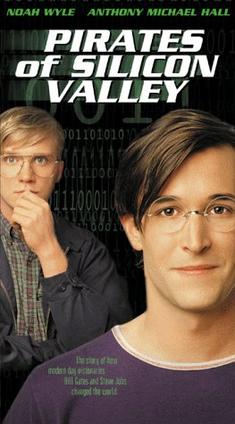
The movie shows the rise of Microsoft and Apple during the 1970-80s. Starting with the college lives of the members of the two camps - Steve Jobs and Steve Wozniak (Apple) on one side, and Bill Gates, Paul Allen and Steve Ballmer (Microsoft) on the other, the movie progresses with the brewing struggle between the two stalwarts, Jobs and Gates. The story documents the trials and tribulations the two camps went through, and the ethical (or unethical?) decisions they took. The movie beautifully depicts Jobs and Gates as individuals - their business acumen, their passion and dream for success, and the way they moulded the destiny of humanity with regards to computers and technology.
I do not want to put the details in here and be a spoilsport. :)
People ought to watch the movie for themselves.
For folks who know most of the facts about the rise of Microsoft and Apple, it might simply be a refreshing summary. But for people who are largely unaware of the history, its an eye-opener!!!
Wednesday, January 10, 2007
Happy New Year
Heart-felt wishes for the new year!!!
For the Christmas holidays, I went back home to enjoy the holidays and new year with my parents. My hometown is Bhubaneswar and I work in Bangalore. I decided to go home quite late and I must tell you that I had a real,real tough time getting tickets for travel. Anyway, I managed to get flight tickets on Kingfisher airlines, for a break journey to Bhubaneswar via Hyderabad.
Flying in India is not as easy on the pocket as in the developed countries (I do not have exact data though.) If one has time and one can endure a long train journey, its probably wise to travel by train from Bangalore to Bhubaneswar. But I must warn you that when I say that the train journey is "long", its really "long" (about 28 hours). Indian readers might not find this unsettling, but such a long journey for some tourist from a developed country would surely not be alluring enough.
It was probably the fourth time I was flying. I had got the aisle seat though I would have surely liked a window seat. Anyway, everything went fine and the flight from Bangalore to Hyderabad soared beyond the clouds in no time. The guy at the window seat in my row dozed off quite soon. I was kinda sleepy too, when suddenly I gazed out of the window. I swear the sight was breath-taking. We were above some clouds and the morning light played on the upper layers of the clouds quite brilliantly. It was all clothed with a shade of orange, and the interplay of light and shadow among the clouds was amazing. I kept on looking at the sight outside and wondered if such a sight was banal enough for the guy dozing off next to me. Anyway, I reached Hyderabad in some time, and then I realized that the flight to Bhubaneswar was delayed due to fog.
In the afternoon, my flight for Bhubaneswar took off and I was really happy that I would be reaching home in a short time. I was reading a Poirot mystery and was looking outside at times to find the sun at its peak; but the light-shadow effect was not as great as in the morning. The flight crowd this time was a bit noisier.

Well, I was starting on my reading session when suddenly an idea occurred to me. Every seat on the flight has a small television screen attached, so that the passenger can watch some television channels and can get important flight-related information. One of the channels was giving information about the flight such as the height we were at, the speed at which we were flying and the outside temperature at the height, a map showing the course of the flight. etc. I thought it would be interesting to see how the outside temperature varied with the height above sea level. So I took out my pen and paper and jotted down the displayed data about outside temperature and height. Just out of curiosity, I have now plotted the data using gnuplot.
Well, the data points do not look like fitting onto a well-known curve. The variation at altitudes closer to the ground level seems quite linear. Although I have fewer data points for the higher altitudes, the variation there looks to be approximately linear too. The only break in the "rough" linearity comes somewhere around 2250 metres. Though I am not quite sure, but my guess is that the clouds were present close to this altitude, which would mean that the upper layers of the clouds would have a higher temperature owing to the direct sunlight, while the area just below the clouds might be cooler. Just a guess though !!!
Some PhD in atmospheric sciences might derive more sense out of this. :)
For the Christmas holidays, I went back home to enjoy the holidays and new year with my parents. My hometown is Bhubaneswar and I work in Bangalore. I decided to go home quite late and I must tell you that I had a real,real tough time getting tickets for travel. Anyway, I managed to get flight tickets on Kingfisher airlines, for a break journey to Bhubaneswar via Hyderabad.
Flying in India is not as easy on the pocket as in the developed countries (I do not have exact data though.) If one has time and one can endure a long train journey, its probably wise to travel by train from Bangalore to Bhubaneswar. But I must warn you that when I say that the train journey is "long", its really "long" (about 28 hours). Indian readers might not find this unsettling, but such a long journey for some tourist from a developed country would surely not be alluring enough.
It was probably the fourth time I was flying. I had got the aisle seat though I would have surely liked a window seat. Anyway, everything went fine and the flight from Bangalore to Hyderabad soared beyond the clouds in no time. The guy at the window seat in my row dozed off quite soon. I was kinda sleepy too, when suddenly I gazed out of the window. I swear the sight was breath-taking. We were above some clouds and the morning light played on the upper layers of the clouds quite brilliantly. It was all clothed with a shade of orange, and the interplay of light and shadow among the clouds was amazing. I kept on looking at the sight outside and wondered if such a sight was banal enough for the guy dozing off next to me. Anyway, I reached Hyderabad in some time, and then I realized that the flight to Bhubaneswar was delayed due to fog.
In the afternoon, my flight for Bhubaneswar took off and I was really happy that I would be reaching home in a short time. I was reading a Poirot mystery and was looking outside at times to find the sun at its peak; but the light-shadow effect was not as great as in the morning. The flight crowd this time was a bit noisier.

Well, I was starting on my reading session when suddenly an idea occurred to me. Every seat on the flight has a small television screen attached, so that the passenger can watch some television channels and can get important flight-related information. One of the channels was giving information about the flight such as the height we were at, the speed at which we were flying and the outside temperature at the height, a map showing the course of the flight. etc. I thought it would be interesting to see how the outside temperature varied with the height above sea level. So I took out my pen and paper and jotted down the displayed data about outside temperature and height. Just out of curiosity, I have now plotted the data using gnuplot.
Well, the data points do not look like fitting onto a well-known curve. The variation at altitudes closer to the ground level seems quite linear. Although I have fewer data points for the higher altitudes, the variation there looks to be approximately linear too. The only break in the "rough" linearity comes somewhere around 2250 metres. Though I am not quite sure, but my guess is that the clouds were present close to this altitude, which would mean that the upper layers of the clouds would have a higher temperature owing to the direct sunlight, while the area just below the clouds might be cooler. Just a guess though !!!
Some PhD in atmospheric sciences might derive more sense out of this. :)
Friday, December 8, 2006
Google PageRank
Ever wondered how the search giant finds the best matches for what you are looking on the web? You might be knowing that it uses some sort of page ranking algorithm to rank content on the web, and finds you the highest ranked content that matches your search. But a little peek into the details of the algorithm would make you think how an idea could be so original and successful, although everything about it seems obvious after its proposed.
Google uses the PageRank algorithm, developed by Larry Page and Sergey Brin in 1998, to calculate the importance of pages on the web. The central idea of the algorithm is the fact that the number of pages that link to a particular page is in direct proportion to the conceived importance or rank of the page. Seems obvious, doesn't it? :)
Read this for a little more detail about the algorithm. The mathematical ideas are quite lucidly explained. If you do not want to go through the maths part, you can skip them happily; the ideas underlying the maths are discussed clearly and one is sure to understand the idea well.
Checkpagerank gives you an approximation of the PageRank of a URL, on a scale of 0-10, 10 being the highest. Type in a URL and have some fun.
Its pretty obvious which URL has a PageRank of 10. :)
Unfortunately, the present blog has a PageRank of zero. Folks, its time to unite and fight for a cause : link to my blog as much as you can !!!
Google uses the PageRank algorithm, developed by Larry Page and Sergey Brin in 1998, to calculate the importance of pages on the web. The central idea of the algorithm is the fact that the number of pages that link to a particular page is in direct proportion to the conceived importance or rank of the page. Seems obvious, doesn't it? :)
Read this for a little more detail about the algorithm. The mathematical ideas are quite lucidly explained. If you do not want to go through the maths part, you can skip them happily; the ideas underlying the maths are discussed clearly and one is sure to understand the idea well.
Checkpagerank gives you an approximation of the PageRank of a URL, on a scale of 0-10, 10 being the highest. Type in a URL and have some fun.
Its pretty obvious which URL has a PageRank of 10. :)
Unfortunately, the present blog has a PageRank of zero. Folks, its time to unite and fight for a cause : link to my blog as much as you can !!!
Sunday, December 3, 2006
"My School"
Sorry readers, this post is not about my school. Its about a TV program aired on National Geographic in India. (I am not sure if the same program is aired by Nat Geo all round the world.)
In this series that covers schools of remote villages in India, each episode is a narration by a small child about his/her daily life - what the daily routine entails, about his/her family and friends, and about his/her school.
The first episode I saw, some days back, was about a child in a village located amidst the mountains of Garhwal. The boy started his day with brushing his teeth with the cool and clear water of the stream flowing near his house. In the cold morning weather, he gathers his school bag and bids his mother goodbye, who's sporting a toothy smile. On the way, he passes by his friend's house, calls out to her, and both of them walk up to the school which is some distance away. He loves his school. At school, the children start the day with a prayer. One can see some children wearing torn shoes but still smiling. The boy likes Mathematics and English - "Maths because it teaches him to count and English because it would enable him to communicate with the external world". He wants to become a teacher when he grows up.
Yesterday, I was surfing through channels on the TV when I came across another episode of the same Nat Geo series. It was about a girl in a remote village in the Gajapati district of Orissa. I had missed the first half of the episode. But in the rest of the episode, the girl was describing what they learnt at school, and I found it really great. The children learnt to identify the letters of the Oriya alphabet in quite an innovative manner. Archery is one skill thats been practised through generations in the tribe. The children use bows and arrows to shoot at a target, which has the letters of the Oriya alphabet written on it. The children stand in a line, and the teacher calls out the letter that the children have to shoot at. This way they learn archery as well as the Oriya alphabet, in one of the most innovative and fun ways possible. At school, the children are also taught about the market trade. Tribals and villages from remote places usually earn a size-able part of their living by selling food products and handicrafts at the nearest town market. So at school, the children play games that makes them learn how to trade stuff, which is again a fun way of imparting education. The girl also talks about her family - consisting of a loving father, a hard-working mother who "never went to school herself, but makes sure that the girl is educated", and a very young kid brother.
Though I have seen only two episodes of this Nat Geo series, I have to admit that I'm impressed by it. Commendable work done by the crew surely!
Its great to know that people in the most under-developed of places even have come to realize the necessity of education, and most importantly education for girls too. Its good to see how education could be imparted the fun way, as a result of which children love to go to school everyday; unlike the monotony of the system in city schools which makes children invent excuses to bunk school. And in my humble opinion, "inventing excuses" would not exactly be categorized as "exercise for the brain" !!!
In this series that covers schools of remote villages in India, each episode is a narration by a small child about his/her daily life - what the daily routine entails, about his/her family and friends, and about his/her school.
The first episode I saw, some days back, was about a child in a village located amidst the mountains of Garhwal. The boy started his day with brushing his teeth with the cool and clear water of the stream flowing near his house. In the cold morning weather, he gathers his school bag and bids his mother goodbye, who's sporting a toothy smile. On the way, he passes by his friend's house, calls out to her, and both of them walk up to the school which is some distance away. He loves his school. At school, the children start the day with a prayer. One can see some children wearing torn shoes but still smiling. The boy likes Mathematics and English - "Maths because it teaches him to count and English because it would enable him to communicate with the external world". He wants to become a teacher when he grows up.
Yesterday, I was surfing through channels on the TV when I came across another episode of the same Nat Geo series. It was about a girl in a remote village in the Gajapati district of Orissa. I had missed the first half of the episode. But in the rest of the episode, the girl was describing what they learnt at school, and I found it really great. The children learnt to identify the letters of the Oriya alphabet in quite an innovative manner. Archery is one skill thats been practised through generations in the tribe. The children use bows and arrows to shoot at a target, which has the letters of the Oriya alphabet written on it. The children stand in a line, and the teacher calls out the letter that the children have to shoot at. This way they learn archery as well as the Oriya alphabet, in one of the most innovative and fun ways possible. At school, the children are also taught about the market trade. Tribals and villages from remote places usually earn a size-able part of their living by selling food products and handicrafts at the nearest town market. So at school, the children play games that makes them learn how to trade stuff, which is again a fun way of imparting education. The girl also talks about her family - consisting of a loving father, a hard-working mother who "never went to school herself, but makes sure that the girl is educated", and a very young kid brother.
Though I have seen only two episodes of this Nat Geo series, I have to admit that I'm impressed by it. Commendable work done by the crew surely!
Its great to know that people in the most under-developed of places even have come to realize the necessity of education, and most importantly education for girls too. Its good to see how education could be imparted the fun way, as a result of which children love to go to school everyday; unlike the monotony of the system in city schools which makes children invent excuses to bunk school. And in my humble opinion, "inventing excuses" would not exactly be categorized as "exercise for the brain" !!!
Wednesday, November 29, 2006
Blog baby, blog !!!
Yep, I was quite immune to the "blog" bug until now. Looks like it has finally broken through my defenses. :)
I ain't sure if I have any definite theme to base my blog upon. But I'm sure a mix of things would not detract visitors either.
To get things started, let me talk about the title of my blog a little. Frankly, I really didn't have a proper title in mind when I created this blog. So I just put in "three words" that came to my mind at that moment. In fact, just before I hit upon the idea of creating the blog, I was reading something online (I can't remember what though) that contained these "three words". So I put those in the "title" field and leaned back in my chair with great appreciation in my eyes - appreciation for those "three words" that made me start liking fiction. My earliest memory of reading fiction in my childhood days is that of poring through the pages of an "illustrated abridged children classic" copy of Moby Dick, borrowed from my best friend. (Thanks to him for getting me started with it.) "Call me Ishmael" are the starting words of Moby Dick !!! :)
Well, I think I'm done with my first post on the blog. Keep visiting for more stuff on various assorted themes. However, I deem it wise to mention that reading my blog during office hours would not necessarily fool your manager to think that you are working more or improving your technical excellence and contributing to the growth of the organization. So visit at your own risk, and sweet time of course.
See ya,
Sambit
PS : In case you want to read up more on Moby Dick or its author Herman Melville, Google and Wikipedia are your friends. You can also find the book online at Project Gutenberg.
I ain't sure if I have any definite theme to base my blog upon. But I'm sure a mix of things would not detract visitors either.
To get things started, let me talk about the title of my blog a little. Frankly, I really didn't have a proper title in mind when I created this blog. So I just put in "three words" that came to my mind at that moment. In fact, just before I hit upon the idea of creating the blog, I was reading something online (I can't remember what though) that contained these "three words". So I put those in the "title" field and leaned back in my chair with great appreciation in my eyes - appreciation for those "three words" that made me start liking fiction. My earliest memory of reading fiction in my childhood days is that of poring through the pages of an "illustrated abridged children classic" copy of Moby Dick, borrowed from my best friend. (Thanks to him for getting me started with it.) "Call me Ishmael" are the starting words of Moby Dick !!! :)
Well, I think I'm done with my first post on the blog. Keep visiting for more stuff on various assorted themes. However, I deem it wise to mention that reading my blog during office hours would not necessarily fool your manager to think that you are working more or improving your technical excellence and contributing to the growth of the organization. So visit at your own risk, and sweet time of course.
See ya,
Sambit
PS : In case you want to read up more on Moby Dick or its author Herman Melville, Google and Wikipedia are your friends. You can also find the book online at Project Gutenberg.
Subscribe to:
Posts (Atom)
